Executive Summary
I led the end-to-end design of IBG — Walmart's internal business growth reporting tool — as the sole Product Designer. The brief was to consolidate 4 disconnected tools. What I found during research changed the scope entirely.
Business analysts at the world's largest retailer were spending 40% of their working week finding and formatting data — not analyzing it. I reframed the problem from a dashboard consolidation task to a workflow reclamation project, and designed a tool that gave that time back. I structured the entire design process around the Double Diamond — two phases of divergence and convergence — to ensure I was solving the right problem, not just the stated one.
My Role
Sole designer from discovery through post-launch iteration. No design team. No design manager. Every decision owned.
I led process observation and stakeholder interviews
I applied Double Diamond and SIT methodology
I defined the IA and component structure
I designed within Walmart's Living Design System
I wrote all user stories and scoped with 5 engineers
I owned QA and post-launch iteration
Sole designer. Fortune 1 scale. End to end.
Research Framework
The Double Diamond. Why I used it here.
The Double Diamond is a design process framework built around two cycles of divergent and convergent thinking. The first diamond defines the right problem. The second designs the right solution. Most projects fail because they skip the first diamond entirely — jumping straight to solutions for a problem nobody validated.
On IBG, stakeholders came in with a defined solution: consolidate the tools. I used the first diamond to challenge that framing — and found that the real problem was not the tools, but the workflows around them. That reframe is what made the second diamond productive.
Discover
Diverge — explore the full problem space without constraints
→
Define
Converge — identify the real problem worth solving
→
Develop
Diverge — explore solution space widely before committing
→
Deliver
Converge — build, test, and ship the right solution
The brief said: consolidate 4 tools into one dashboard. I didn't open Figma. I spent 4 weeks embedded with the teams who would actually use the product — watching them work, not asking them to describe their work. This is the diverge phase: cast wide, observe everything, make no assumptions about what matters yet.
Methods I used in this phase:
01
Process Observation — watching over interviewing
I sat with analysts during their actual working sessions. Not interviews — observation. I mapped every step, every tool switch, every moment of friction. The distinction matters: people describe an idealized version of their work in interviews. Observation shows you the reality. This is where the 40% figure came from — not a survey, not a question — watching a working week unfold.
02
Stakeholder Interviews — 3 user groups, interviewed separately
I interviewed business analysts, operations managers, and team leads individually — never in groups. Group interviews produce consensus answers and suppress minority experiences. I needed to understand how differently these three groups experienced the same data environment. Result: each group had a completely different mental model of what "good" looked like.
03
Task Analysis — mapping every step in the current workflow
I documented the full task flow for each user group: what tool they opened first, what they did with it, where they switched, what they copied, what they reformatted. The task analysis revealed 7 distinct workflow breakpoints — moments where the process required manual intervention. Each breakpoint was a design opportunity.
04
User Surveys — quantifying what observation surfaced
After observation and interviews, I ran a structured survey to quantify patterns I'd seen qualitatively. This turned subjective observations into defensible numbers — including the 40% time loss figure that became the central metric for the entire project. Surveys after observation, not before — they quantify patterns, not replace discovery.

User Interview Template · Clarify Phase · 3 user groups

Research Synthesis · Patterns across 3 user groups
Discovery produced more than I could solve. The define phase is about convergence — taking everything observed and distilling it into a single, precise problem statement that the team can align around. This is where the brief gets challenged.
40%
of an analyst's working week — roughly 16 hours — spent finding and formatting data. Not analyzing it. Not acting on it. Finding it and making it readable.
— Quantified through process observation + user survey · Walmart IBG discovery phase
The original brief was: consolidate the tools. The defined problem was: analysts are losing 16 hours a week to work the tool should be doing for them. Those are not the same brief. The first leads to a better-looking version of the same problem. The second leads to a fundamentally different product.
I mapped research findings to a problem statement, two user personas, and a set of "How Might We" questions that became the brief for the second diamond. The HMW questions that shaped the most design decisions:
HMW
How might we eliminate the data formatting step entirely?
Not reduce it. Eliminate it. If formatting is manual, the system is failing. This question pushed toward real-time data surfacing rather than report generation.
HMW
How might we serve a non-technical manager without hiding capability from an analyst?
The two user groups had conflicting needs. This question forced a structural solution — separate entry points, shared data — rather than a compromise that would have failed both groups.
HMW
How might we surface anomalies before the analyst goes looking for them?
This question produced the contextual alert system — a feature nobody had asked for, discovered through SIT's Function Follows Form principle applied to the defined problem.
With the right problem defined, I entered the second diverge phase — exploring multiple solution directions before committing to any of them. This is where SIT (Systematic Inventive Thinking) became the primary method. As a solo designer without a workshop team, I needed structured ideation rather than free-form brainstorming.
01
SIT — Function Follows Form · 3 features nobody asked for
Starting from the existing tool structure rather than user wish lists, I systematically asked: what could this component do that it doesn't currently do? This produced three features the brief hadn't specified — including the anomaly alert system and a contextual drill-down that let non-technical users explore data without being overwhelmed. Users don't ask for what they've never seen work.
02
SIT — Task Unification · 40% fewer navigation steps
I identified workflows that crossed multiple tools and asked: what if one component could do everything this workflow requires? Multi-tool steps collapsed into single contextual components. The result was a 40% reduction in navigation steps against the baseline workflow — not through simplification, but through unification. Fewer steps means fewer abandonment points means more decisions made.
03
SIT — Division · Modular steps for non-technical users
Complex workflows broken into discrete, independently completable steps. A team lead could act on a data signal without understanding the full system behind it. Each step was designed to succeed on its own — so partial completion still produced value. Non-technical users could self-serve for the first time.
04
Skeleton wireframes shared with engineers before high-fidelity
Before investing design time in pixel-perfect work, I shared skeleton wireframes with the engineering team to surface technical constraints. Three major navigation changes were identified and resolved in this phase — none reached development. The customizable dashboards requirement was caught here and shaped the entire component architecture. Zero rework after handoff.

Low-Fidelity Wireframes · Develop Phase
Mid-Fidelity Prototype · User Testing
The deliver phase is where the second diamond converges — taking the best solutions from the develop phase and building them to production quality. For IBG, this meant working within Walmart's Living Design System, writing every user story, and owning QA end to end.
Every component was built within Walmart's Living Design System — Avenir Next typography, Walmart brand tokens, WCAG AA compliance throughout. Because IBG matched the patterns employees already used across every other internal Walmart tool, adoption required no training. The interface was familiar on day one.
I formally audited accessibility — keyboard navigation, ARIA labels, and screen reader support tested and documented before handoff. I wrote every user story and scoped every ticket with the five front-end engineers. No translation layer between design intent and build. No rework after handoff.

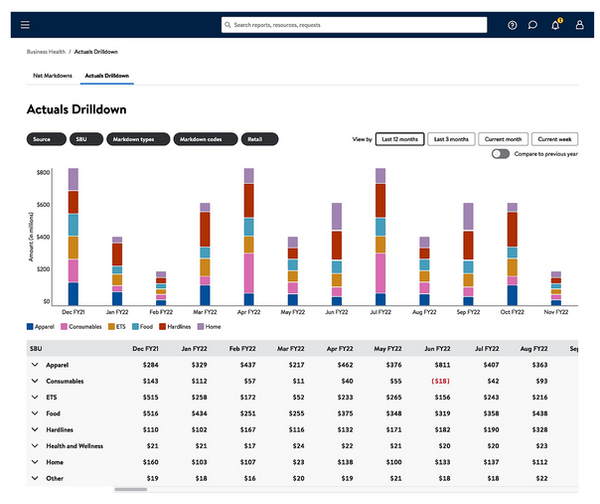
Final IBG Dashboard · Production Ready ✓

Component Library · Walmart Living DS

Color & Typography · Brand Tokens
Before & After
What the Double Diamond actually changed.
The shift wasn't cosmetic. Applying the Double Diamond meant solving the right problem — and the before/after reflects that.
The old reality
4 tools to check for one data picture. Reports on data 24–48 hours stale. 40% of analyst time lost to formatting. Non-technical managers blocked without analyst support. 7 manual workflow breakpoints. No single source of truth.
What changed
One real-time dashboard. 30% reduction in manual processing time. 40% fewer navigation steps. Non-technical users self-sufficient. Contextual anomaly alerts surfaced proactively. WCAG AA compliant. Zero training required.
Impact
Hours given back. At Fortune 1 scale.
The 30% reduction in manual processing time is the headline — but at Walmart's scale, that percentage represents thousands of analyst hours per week compounding across the organization. The Double Diamond made it possible by ensuring the product solved the real problem, not the stated one.
30%
Reduction in Manual Processing Time
Analysts reclaimed hours lost to data hunting and formatting. At Fortune 1 scale, that compounds.
4 → 1
Tools Consolidated
Power BI, SharePoint, Excel, and manual pipelines replaced by one real-time source of truth.
0
Rework After Handoff
Skeleton wireframes early, user stories written by the designer, constraints caught before development began.
Reflection
What the Double Diamond proved on this project.
The first diamond is the most important investment. Stakeholders came in with a solution — consolidate the tools. If I had accepted that framing and opened Figma immediately, I would have built a marginally better version of the same broken system. The four weeks of discovery and the rigor of the define phase produced the 40% insight that made everything else defensible.
SIT works without a workshop team. Applying structured ideation as a solo designer — Function Follows Form, Task Unification, Division — produced features and architecture decisions that free-form brainstorming would not have reached. Structure enables creativity under constraint. It doesn't limit it.
What I'd do differently: I would involve the non-technical manager group earlier in the develop phase. Their feedback at mid-fidelity surfaced assumptions about data literacy I'd made in the skeleton wireframe stage. Catching those assumptions one phase earlier would have saved a full iteration cycle.
The Double Diamond isn't a process for its own sake. It's a forcing function — it makes you prove the problem before you solve it. On IBG, that proof changed everything. The 30% time saving exists because the first diamond worked.
— Mahesh Guntivenkata · Walmart IBG